About ACME Car company
A Legacy Built in Fiberglass
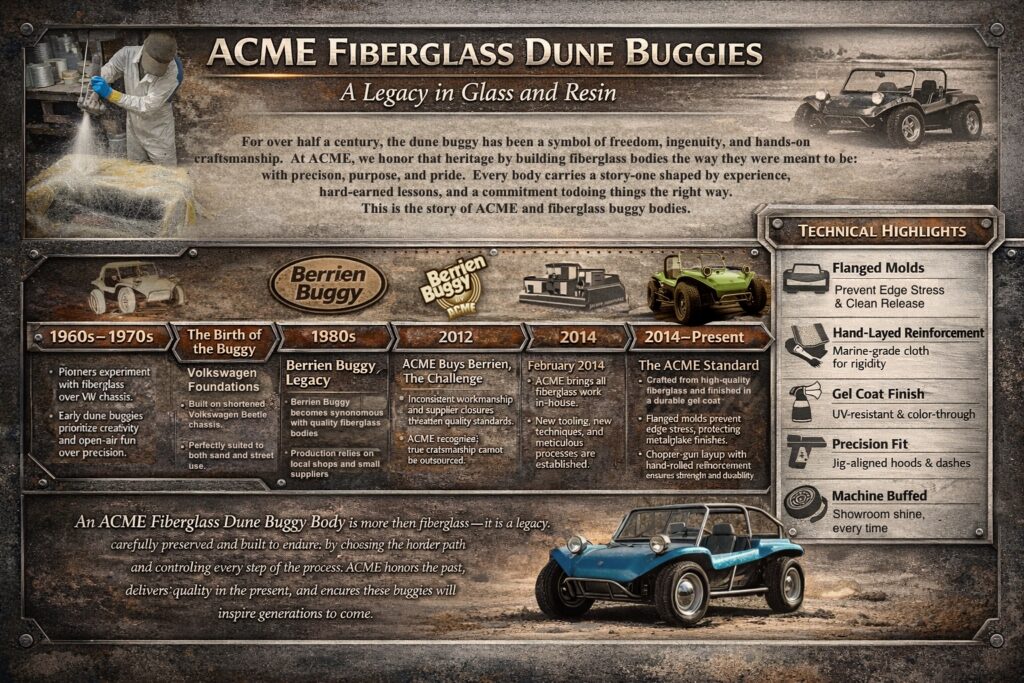
An ACME Dune Buggy Body is more than fiberglass—it is a legacy, carefully preserved and built to endure. By choosing the harder path and controlling every step of the process, ACME honors the past, delivers quality in the present, and ensures these buggies will inspire generations to come.
A Great Beginning
Every ACME fiberglass dune buggy body carries a story shaped by experience, hard-earned lessons, and respect for how things should be built. When ACME took on the Berrien Buggy legacy, the mission was simple: preserve a great tradition.
At first, fiberglass bodies were produced by outside shops—but that approach didn’t last. Inconsistent workmanship, limitations with metal-flake finishes, and the sudden loss of a supplier made one thing clear: true quality couldn’t be outsourced. If the bodies were going to meet ACME standards, they had to be built in-house.
In February 2014, ACME made that decision. Fiberglass production came home.
The transition required new tooling, new techniques, and countless hours refining processes others take for granted. But it changed everything. From that point forward, every ACME body would be shaped, reinforced, and finished under one roof—by craftsmen who care deeply about the result.
Controlling the entire process defines the ACME difference. From mold preparation to final polish, nothing is rushed and nothing is assumed. Our molds are meticulously cleaned, maintained, and prepared the same way every time, because consistency is what turns craftsmanship into reliability.
We use flanged molds for a reason learned through experience. Without a perimeter flange, releasing a body can introduce edge stress that may not appear until months or years later—especially in metal-flake finishes. Our flanged molds allow the body to release cleanly. Once free, the flange is trimmed away, leaving strength where it matters.
It’s a small detail—but small details separate good bodies from great ones.
ACME bodies are laid up using a chopper gun in four controlled sections. Two craftsmen work alongside the gun operator, rolling the fiberglass as it’s applied to ensure full saturation and eliminate trapped air. It’s a hands-on process that simply can’t be automated.
We don’t chase thickness for weight alone. True strength comes from knowing where to reinforce. That’s why every ACME body receives hand-laid, heavy marine-grade boat cloth along the flat vertical sides, providing exceptional rigidity without unnecessary bulk.
Once the structure is complete, the exterior is painted black for a clean, finished appearance. The hood and dash assembly are then mounted using a precision jig fixture to ensure proper alignment every time.
The final step is machine buffing the entire body—not just for shine, but for pride. Buffing reveals the depth of the finish and ensures every body leaves our shop looking as solid as it feels.
What defines an ACME body isn’t paint—it’s gel coat. A blend of clear resin and pigment or metal-flake, gel coat is sprayed directly into the mold, meaning the mold’s surface becomes the finished surface you see.
After the gel coat sets, fiberglass and resin are applied behind it, forming a chemical bond that creates a unified, durable structure. The result is a color-through finish that resists chips, wear, and time.
An ACME fiberglass dune buggy body is the result of choosing the harder path to do things right. We build the way craftsmen always have—with control, accountability, and pride. We know every step because we live it every day. That’s why when you buy an ACME body, you’re not just buying fiberglass—you’re buying a legacy built to last.
Ready to Start Your Build?
Contact ACME Car Company
Let’s discuss your project or VW needs. Our team is here to help you every step of the way.